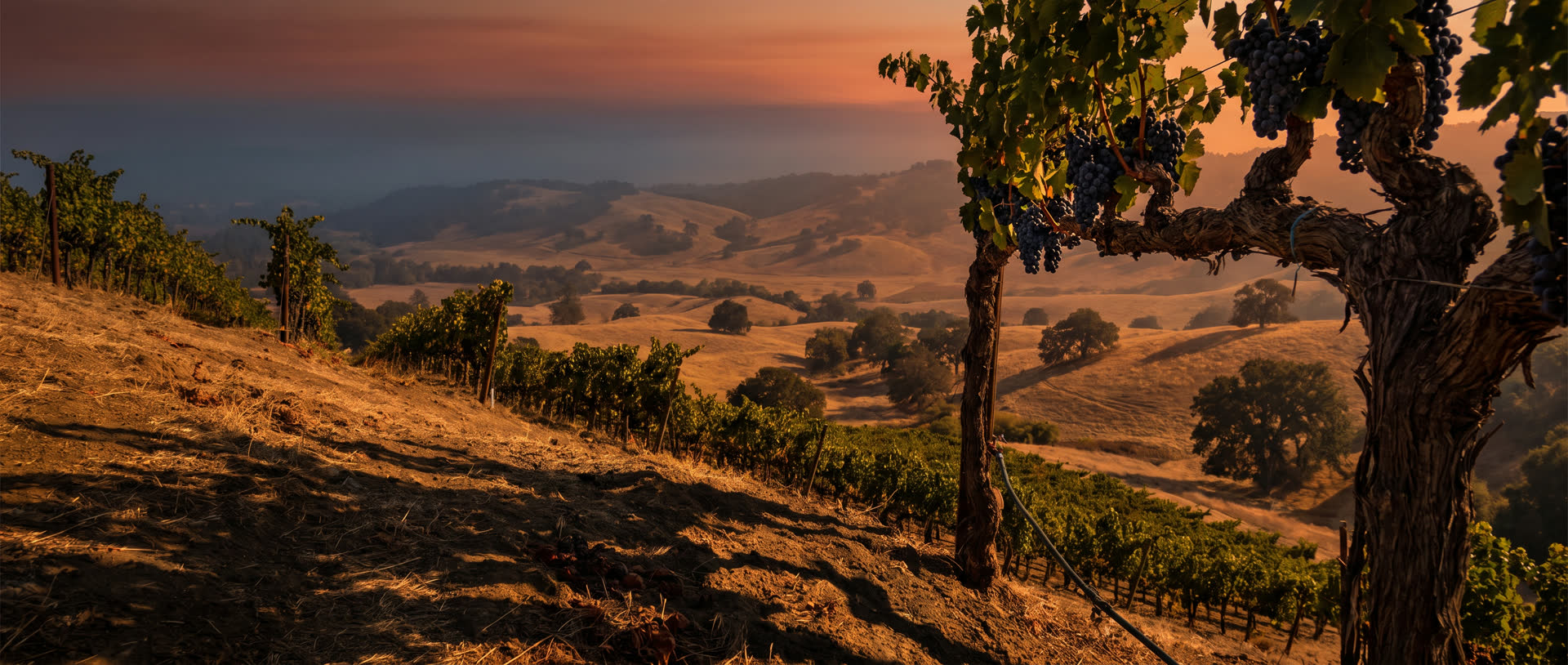
Wine made by gravity.
A three-level winery built into the side of a Dry Creek Valley hill, where the wine falls from crush to barrel by gravity alone — no pumps, no buffeting. Over two hundred feet of caves, naturally cool, carved into the hillside in the late 1970s.
It starts at the hilltop,where the fruit arrives.
From there, one direction:down.
Into the hill,where stone keeps it cool.
Over two hundred feet of caves, naturally cool, carved into the hillside in the late 1970s.
Go undergroundThe gravity-flow descent
Most wineries push juice uphill with pumps. Fritz lets the hill do the work. From the crush pad at the top, the wine moves down through three tiers by gravity — gentler on the fruit, lighter on the land.
Fruit arrives at the hilltop
Harvest begins at the highest point of the winery. Grapes are received and crushed at the top of the hillside structure, so that everything which follows can travel in one direction only: downward, with gravity.
Crushing · Level oneThe juice falls to the tanks
Rather than pumping the must to fermentation, it descends to the middle tier on its own weight. Forgoing pumps saves energy — and spares the wine the bruising pulsation and buffeting that pumping forces on delicate juice.
Fermentation · Level twoAging in the hillside caves
At the bottom, more than two hundred linear feet of caves stretch into the hill. The earth holds them naturally cool year-round — ideal cellaring for the reds, with no carbon-heavy cooling common to modern wineries. Stone does the climate control.
Aging · Level threeA monument built ahead of its time — wine shaped not by machinery, but by gravity, stone, and the cool of the earth.
The small-lot wines
Small-lot production. Current releases and vintages vary — written here from the winery's own program.
Stone, gravity, and cool air
A subterranean winery that works with the land instead of against it — efficient by design, decades before it was fashionable.
Taste below the surface
Sit at the top of Dry Creek Valley and taste the wines where they're made — beside the very caves that aged them. Visits to the underground winery are best arranged ahead; reach out and the family will set your time.
Cloverdale, CA 95425
Northern Dry Creek Valley, Sonoma County
info@fritzwinery.com
(707) 894-3389